Summary:
You’ve seen the before-and-afters. Maybe you’ve priced out a derma roller on Amazon. Maybe you’ve already tried one. And now you’re wondering whether spending $300 on a single professional session makes sense when a roller costs $30 and ships in two days.
It’s a fair question. The answer isn’t what most spa websites will tell you, because most of them skip the part that actually matters: the two options don’t produce the same results. Not close. Not “similar but slower.” Categorically different outcomes.
Here’s what you need to understand before you spend money on either.
Home Microneedling Before and After: What At-Home Results Actually Look Like
At-home microneedling tools — mostly derma rollers — have gotten a lot of attention because they’re accessible, affordable, and easy to use. And they do something. Consistent use of a quality roller can improve product absorption and give your skin a slightly smoother texture over time. That’s real, and it’s worth saying.
But the before-and-after results you see from home rollers are surface-level — literally. Most consumer-grade derma rollers operate at a needle depth of 0.25mm to 0.5mm. At that depth, you’re working in the outermost layers of the skin. You’re not triggering the collagen and elastin response that makes professional microneedling worth the conversation in the first place.
The wound-healing mechanism that drives real structural change in your skin requires reaching deeper tissue — and home tools simply don’t get there.
Before After Derma Roller: Why the Depth Gap Changes Everything
Here’s the detail most comparison articles gloss over: the FDA-cleared SkinPen device we use in our professional settings can reach treatment depths that home rollers can’t legally or safely approach. That depth difference isn’t a technicality — it’s the entire mechanism behind the results.
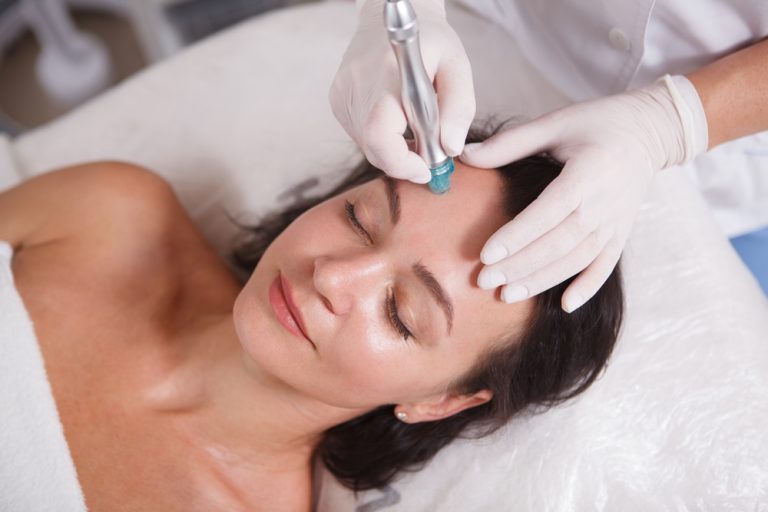
When a professional device creates micro-channels at the right depth, your skin interprets it as controlled injury and responds by producing new collagen and elastin. That’s the process that actually improves the appearance of acne scars, smooths uneven texture, and reduces the visibility of fine lines over time. It takes weeks to show up because collagen production is a biological process, not an immediate reaction. But when it does show up, it’s structural — the kind of change that a derma roller working at 0.25mm simply cannot replicate.
The before-and-after photos that stop people mid-scroll — the ones showing real improvement in acne scarring, hyperpigmentation, or skin tone — are almost always the result of a professional treatment series, not a home roller used consistently over months. That’s not a knock on home tools. It’s just the physics of what different needle depths can accomplish.
There’s also the safety side of this. Professional microneedling uses sterile, single-use needle cartridges that are disposed of after every session. Home rollers, even when cleaned carefully, accumulate bacteria and dulling over time. Using a dull or contaminated roller on compromised skin can cause irritation, breakouts, or worse — and there’s no numbing cream, no skin assessment, and no trained eye evaluating your skin before you start.
For someone dealing with hyperpigmentation or post-acne marks — concerns that are extremely common among Wake County, NC residents given the region’s UV intensity and diverse skin tones — using the wrong tool or the wrong technique can actually deepen discoloration rather than improve it. That’s a real risk that doesn’t get mentioned enough in the “save money with a home roller” conversation.
At-Home Microneedling Before After: What the Results Tell You About What You Need
If you’ve already tried at-home microneedling and felt underwhelmed by the results, that’s not a failure on your part — it’s information. It tells you that what you’re trying to address likely requires a deeper intervention than a surface-level tool can provide.
The most common concerns people bring to our professional microneedling consultation are acne scarring, uneven skin tone, fine lines, and textural roughness. These aren’t surface issues. They’re changes that happened in the deeper layers of the skin — which is exactly where professional treatment works, and where home tools stop short.
Microneedling at home before after comparisons can look encouraging in the short term, especially if you’re using a good skincare routine alongside your roller. But that improvement is often driven by better product absorption rather than structural skin change. When people switch to professional sessions after months of home rolling, they typically see a different quality of result — not just smoother surface texture, but genuine improvement in the underlying concerns they were trying to address.
This matters for budgeting decisions too. If you’ve already spent six months and a few hundred dollars on home tools without the results you wanted, the relevant question isn’t “can I afford a professional session?” It’s “how much longer do I want to spend on something that isn’t working?” A professional series of three to six sessions, spaced about a month apart, is designed to produce cumulative results that compound with each treatment. Most people see noticeable improvement after the second or third session — and those results continue developing for weeks after the series ends.
For clients in Wake County, NC dealing with specific skin concerns — particularly hyperpigmentation, which is worsened by the region’s intense summer UV exposure — the difference between surface-level tools and professional treatment isn’t just about aesthetics. It’s about choosing the right tool for the actual problem.
What Professional Microneedling Actually Costs in Wake County, NC in 2026
Nationally, microneedling costs somewhere between $100 and $750 per session, with a national average around $300. In the Raleigh, Wake Forest, Cary, and surrounding Wake County, NC areas, pricing across local providers generally falls in the $200–$700 range per session, depending on the provider’s credentials, the device used, and whether the treatment is combined with other services.
At Wake Skincare, a single microneedling session is approximately $300. That price includes a thorough skin assessment, professional-grade numbing cream, the SkinPen treatment itself, and post-treatment care instructions. It’s not 30 minutes of needle time — it’s a complete clinical protocol.
How Many Microneedling Sessions Do You Actually Need?
This is the question that matters most for budgeting, and it’s the one most providers answer vaguely. So here’s a straight answer: it depends on what you’re treating, but there are clear general guidelines.
For moderate acne scarring or significant texture concerns, most clients need three to four sessions spaced about a month apart. For anti-aging goals and general skin improvement, four to six sessions is a more realistic timeline. Maintenance sessions once or twice a year help sustain results after the initial series is complete.
When you do that math, a full treatment series runs somewhere between $900 and $1,800 for the initial sessions, depending on how many your skin needs. Nationally, most people who commit to professional microneedling spend between $700 and $2,000 per year when accounting for a full series and occasional maintenance. That’s a meaningful investment — but it’s also a different category of result than what you’ll get from even the most consistent at-home routine.
It’s also worth understanding what you’re comparing that number to. Many people spending $200–$300 a month on serums, retinoids, and specialty skincare products to address the same concerns are already approaching that annual spend — without the structural skin improvement that professional treatment produces. The math looks different when you factor in what you’re actually getting.
One more thing worth knowing: microneedling results don’t show up the next day. Collagen production is a biological process that takes weeks to become visible. The redness after a session typically resolves within a few days, and the real improvement continues developing for weeks after that. This is a treatment series, not a quick fix — and we’ll tell you that upfront.
How to Choose a Microneedling Provider in Wake County, NC — and What to Actually Look For
Wake County, NC has no shortage of options. Between boutique med spas, multi-location chains, and physician-owned practices across Raleigh, Wake Forest, Cary, Knightdale, and surrounding areas, you’ll find providers at every price point. The challenge isn’t finding someone who offers microneedling — it’s knowing what separates a qualified provider from someone who bought a device and started booking appointments.
Here’s what actually matters. First, the device. The SkinPen is the only FDA-cleared microneedling device in the United States. That clearance means its safety and efficacy have been independently reviewed. If a provider can’t tell you what device they’re using or whether it’s FDA-cleared, that’s a meaningful gap.
Second, credentials. North Carolina only formally added microneedling to the licensed esthetician scope of practice in July 2022, and even then with specific requirements: an FDA-approved device, proper training, and a maximum depth of 1.0mm for estheticians operating without physician oversight. This is recent regulatory history that many buyers don’t know — and it means you should be asking your provider about their training and their device, not just their price.
Third, specialization. If you’re dealing with hyperpigmentation, acne scarring, or you have a darker skin tone, you need a provider who has specific experience with those concerns. Microneedling on skin of color carries real risks — particularly post-inflammatory hyperpigmentation — that require a practitioner who knows how to manage them. A provider who treats all skin types the same way is not the same as one who has built their practice around these specific concerns.
At Wake Skincare, our founder Jacqueline Grace is a licensed esthetician who trained in New York and has been named Best Esthetician in Wake County, NC three consecutive years by the Wake County community — including First Place, Best Esthetician in the Wake Weekly Best of the Best 2022. She placed first internationally in Pigmentation Artist of the Year at The Skin Games, which is the single most relevant credential for anyone dealing with pigmentation concerns. Our clinic operates under the oversight of a named medical director, uses the FDA-cleared SkinPen, and specializes in skin of color, acne, hyperpigmentation, and anti-aging. Every new client starts with a free skin evaluation — no commitment, no pressure, just a real conversation about what your skin needs and what results are realistic.
Those are credentials you can look up.
Is Professional Microneedling Worth the Cost? Here's the Honest Answer
If your concern is surface texture and you’re happy with gradual, modest improvement, a quality home roller used consistently might be enough. But if you’re dealing with acne scars, hyperpigmentation, or visible signs of aging that haven’t responded to your current routine, a home tool operating at 0.25mm to 0.5mm depth is not going to get you where you want to go.
Professional microneedling — done with the right device, by a qualified provider, with the right number of sessions for your specific concern — produces a different category of result. The cost per session is real, so is what you’re getting: a clinically designed protocol, a trained eye assessing your skin before every treatment, and a treatment depth that actually triggers the collagen response driving the results you’re after.
If you’re in Wake County, NC and ready to have a real conversation about whether microneedling is the right fit for your skin, we offer a free consultation to start. No obligation — just an honest assessment of what your skin needs and what’s realistic.