Summary:
If you’ve been dealing with melasma for a while, you already know the frustrating part isn’t finding information — it’s finding information you can actually trust. You’ve probably read about hydroquinone, IPL, chemical peels, and a dozen other options. Some of it contradicts itself. Some of it glosses over the risks. And almost none of it tells you what to expect when you’re not starting with light skin.
This page cuts through that noise. We’ll walk you through the treatments that have the strongest evidence behind them, what they’re best suited for, and why the wrong choice — especially for medium-to-dark skin tones — can make things worse instead of better.
Best Melasma Treatment Options: What the Evidence Actually Shows
Melasma is a chronic, relapsing pigmentation condition — which means there is no single treatment that fixes it permanently. That’s not a pessimistic take; it’s just the reality that the clinical research consistently reflects. Understanding that upfront changes how you evaluate your options, because you stop looking for a cure and start looking for a protocol that works long-term.
The most established topical treatment is still triple combination cream — a formulation of hydroquinone, tretinoin, and a low-potency corticosteroid — which has the strongest evidence base among all topical options. Hydroquinone alone at 2–4% concentration is also widely used and clinically validated. More recently, oral tranexamic acid has emerged as a strong first-line option, with solid evidence for efficacy and a favorable safety profile.
In-office treatments like chemical peels, IPL, and fractional laser can produce meaningful results, but they carry real risks if not matched carefully to the individual. That’s where provider expertise matters more than the equipment.
Dark Spot Treatment vs. Melasma Treatment: Why They're Not the Same
This distinction matters more than most people realize. Sun spots — the kind that show up as isolated, well-defined marks from years of UV exposure — and melasma might look similar at a glance, but they behave very differently and respond to different treatments.
Melasma has a hormonal component that ordinary dark spots don’t. It’s commonly triggered by estrogen and progesterone shifts, which is why it shows up so frequently during pregnancy, while using hormonal birth control, or during perimenopause. That hormonal driver means sun avoidance alone won’t resolve it, and treatments that work well for standard sun damage may not address what’s actually causing the pigmentation to keep returning.
Melasma also tends to appear in larger, blotchy patches — most often across the cheeks, forehead, and upper lip — rather than the smaller, more defined spots that come from direct sun exposure. It can also have a vascular component, meaning blood vessel activity in the skin plays a role in how it develops and how it responds to treatment.
If you’ve had treatments for “dark spots” that haven’t worked the way you expected, it may be because the approach was designed for a different kind of pigmentation entirely. Melasma needs to be treated as melasma — with that hormonal trigger, that vascular component, and that chronic nature all factored into the plan. Getting that assessment right at the start is the difference between a protocol that makes progress and one that spins its wheels.
Why Aggressive Melasma Treatments Can Backfire — Especially for Darker Skin Tones
One of the most common concerns we hear from people researching melasma treatment — and it’s a well-founded one — is the worry that the wrong treatment will make things worse. That fear is backed by real clinical evidence.
Melasma is easily provoked by inflammation. When a treatment creates too much heat or irritation in the skin, it can trigger post-inflammatory hyperpigmentation (PIH) — a different kind of darkening that can be just as stubborn as the melasma itself. This risk is highest with aggressive laser protocols and strong chemical peels, and it’s significantly higher for people with medium-to-dark skin tones (Fitzpatrick types III through VI).
This is a population that’s disproportionately affected by melasma to begin with. Studies show melasma is far more prevalent in Fitzpatrick types III–VI, and darker skin tones also have a more pronounced and sustained hyperpigmentation response to visible light exposure. That combination — higher prevalence, higher treatment risk — means that finding a provider who genuinely understands how to treat skin of color isn’t a preference, it’s a safety consideration.
The providers who get the best results with melasma in darker skin tones are the ones who take a conservative, layered approach: starting with what the skin can tolerate, building incrementally, and adjusting based on how the skin responds. That requires experience and judgment, not just access to equipment.
At Wake Skincare, this is an area we’ve invested in specifically. Jacqueline Grace has earned first and second place in the Pigmentation Artist of the Year category at The Skin Games — an international aesthetics competition — and our practice explicitly specializes in skin of color. Those aren’t incidental details. They reflect a deliberate focus on getting this right for clients whose skin requires a more careful approach.
What a Real Melasma Treatment Plan Looks Like in Wake County
Living in Wake County adds a layer of context that most generic treatment guides don’t account for. Our summers are long, hot, and humid — July highs average around 90°F — and UV accumulation starts building in April and doesn’t let up until September. For anyone managing melasma, that’s a six-month window where triggers are consistently active.
That seasonal reality shapes how we approach treatment planning here in Wake Forest, Raleigh, Cary, Apex, and throughout Wake County. Fall and winter are the optimal windows for IPL, chemical peels, and more intensive in-office treatments, because UV exposure is lower and the skin can recover without being immediately re-exposed to the conditions that drive melasma in the first place. We see a consistent surge of clients in late summer who’ve watched their pigmentation worsen over the season and are ready to take action — and for most of them, timing the treatment into the cooler months makes a meaningful difference in results.
Which In-Office Treatments Work Best for Melasma?
There isn’t a single best in-office treatment for melasma — the right choice depends on your skin type, the depth of your pigmentation (epidermal, dermal, or the more common mixed type), and what you’ve already tried. But there are a few modalities that consistently show up in both the clinical literature and in real-world results.
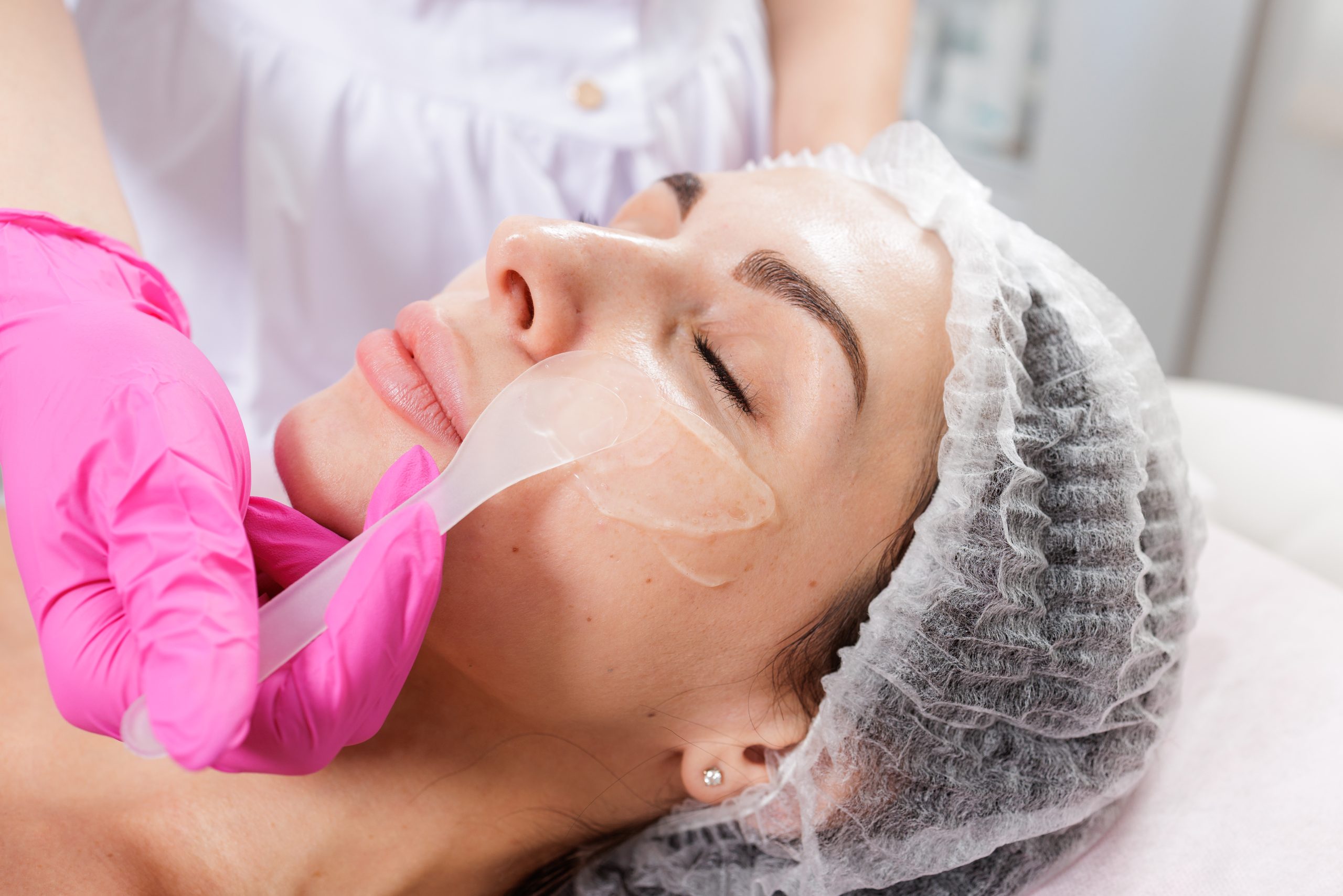
Chemical peels, particularly glycolic acid-based peels, have solid evidence behind them for melasma. They work by accelerating cell turnover and gradually reducing pigmentation in the upper layers of the skin. The VI Peel is one of the formulations we use at Wake Skincare — it’s designed specifically for hyperpigmentation and melasma, and it works across a range of skin types when applied correctly.
IPL (Intense Pulsed Light) can be effective for melasma, but it requires careful patient selection. It tends to work better for epidermal melasma in lighter skin tones, and it carries a higher risk of triggering PIH in darker skin. It’s not a treatment to approach without a thorough assessment first. Clear and Brilliant, a gentler fractional laser, is another option we use for pigmentation — it creates less thermal stress than more aggressive laser platforms, which makes it more suitable for a broader range of skin tones.
HydraFacial with targeted brightening boosters — including britenol, which is specifically formulated for hyperpigmentation — is a lower-intensity option that works well as part of an ongoing maintenance protocol. It’s not a standalone solution for significant melasma, but it plays a real role in supporting and sustaining results between more intensive treatments.
What works best in practice is usually a combination of these modalities, layered thoughtfully over time. Melasma that has been present for years rarely responds to a single session of anything.
How to Choose a Melasma Provider in Wake County — What to Actually Look For
The Research Triangle has no shortage of aesthetics providers, and most of them will tell you they treat melasma. The harder question is how to evaluate who’s actually equipped to treat it well — especially if you have medium-to-dark skin or you’ve had treatments elsewhere that didn’t deliver.
A few things are worth looking for specifically. First, does the provider have documented expertise in pigmentation — not just general aesthetics experience, but a demonstrated focus on this specific area? Competition credentials, continuing education in hyperpigmentation, and a track record with clients who have similar skin concerns are all more meaningful than years in business alone.
Second, do they assess before they treat? A thorough consultation that looks at your skin type, the depth and pattern of your melasma, your hormonal history, and your prior treatments is the foundation of a protocol that will actually work. Providers who skip straight to recommending a treatment without that assessment are cutting a corner that matters.
Third, are they honest about what treatment can and can’t do? Melasma is a chronic condition. A provider who tells you it can be significantly reduced and managed — but who also tells you it requires ongoing maintenance and that sun protection is non-negotiable — is telling you the truth. One who promises to eliminate it permanently is not.
At Wake Skincare, Jacqueline has been named Best Esthetician in Wake County three consecutive years running, holds a Master certification in HydraFacial (among the first 100 practitioners in the world to reach that level), and operates under the oversight of a medical director. Every new client starts with a free consultation — no pressure, no upselling, just an honest look at your skin and a realistic conversation about what’s possible.
Finding the Right Melasma Treatment Starts with an Honest Assessment
Melasma is manageable. It’s not a condition you have to just live with, but it also isn’t one that responds well to guesswork or one-size-fits-all protocols. The treatments with the strongest evidence — whether topical, procedural, or a combination of both — all work better when they’re matched carefully to your skin type, your triggers, and your history.
If you’ve been going in circles with melasma, the most useful next step isn’t another product. It’s a real conversation with someone who specializes in this specific condition and understands what your skin actually needs.
We offer free consultations to all new clients in Wake County. Come in, get an honest assessment, and find out what a treatment plan built around your skin actually looks like.