
Summary:
If you’ve started looking into microblading in Wake County, you’ve probably noticed that prices jump all over the place. One studio charges $299. Another charges $650. A quick search pulls up a Groupon and a med spa listing on the same page, and nothing tells you why the gap is so wide or which one is actually worth your money.
That confusion is worth taking seriously — because microblading isn’t a haircut. It’s a semi-permanent procedure that lives on your face for 12 to 18 months. Getting it right matters. This page explains what actually drives microblading cost in Wake County, what you should expect to pay, and how to know whether a price is a deal or a warning sign.
What Does Microblading Cost in Wake County, NC?
In Wake County and the Cary area, professional microblading typically ranges from $400 to $800 for the full service. That range holds across most credentialed studios in the Triangle. The broader North Carolina market — factoring in artist experience and location — runs from around $250 to $850.
The national average sits somewhere around $400 to $600, depending on the source. Very in-demand artists in major metro areas charge $2,000 or more. The point isn’t to memorize a number — it’s to understand that the price reflects something real, and that a session priced well below the local market floor is usually priced that way for a reason.
Why Does Microblading Cost So Much More at Some Wake County Studios?
You’re not just paying for pigment and a needle. You’re paying for the artist’s eye, their training, the quality of what they put in your skin, and the judgment call they make before they ever touch your face.
Experienced artists charge more because their results hold up. Not just in the chair — but six weeks later when the skin has healed, the pigment has settled, and you’re looking at the finished product in your bathroom mirror. That’s the result that matters. A beginner might deliver a clean session, but the healed outcome is where skill really shows. Pigment can shift color. Strokes can blur. Brows that look sharp on day one can look muddy by week four if the depth or technique was off.
Artist credentials are a real differentiator here, not just marketing language. Competition placements, named certifications, and years of experience in a specific technique all correspond to outcomes — not just optics. When an artist has placed first in Pigmentation Artist of the Year at an international competition like The Skin Games, that’s a peer-judged result based on actual work. It’s a different category of credential than a certificate from a weekend course.
There’s also a meaningful difference between a standalone microblading studio and a medically supervised aesthetic clinic. Medical oversight adds a layer of accountability and safety that matters when you’re choosing someone to work on your face with a blade. It’s not a guarantee of quality on its own, but it signals a level of seriousness about the practice that not every provider in Wake County can claim.
Finally, what’s included in the price matters. Many providers charge separately for the 6-to-8-week touch-up that’s a standard part of the microblading process. If a $350 session doesn’t include that follow-up, you’re not actually comparing it to a $600 session that does.
Does Your Skin Type Affect What You Should Pay For?
This is the question most people don’t think to ask — and it’s one of the most important ones.
Traditional microblading creates fine, hair-like strokes in the upper layer of the skin. On dry to normal skin, those strokes hold their definition well. But on oily skin, or in a humid climate where your skin is producing more oil than it might elsewhere, those strokes can blur over time as the pigment spreads slightly beneath the surface. The result is a brow that looks softer and less defined than it did when you left the studio.
This matters in Wake County specifically. The Triangle’s humid subtropical summers are not kind to hair-stroke microblading on oily skin. If you’re spending a full day outdoors in July, sweating through a workout, or just running naturally oily, your skin may not hold traditional microblading the way someone with dry skin in a drier climate would. That’s not a flaw — it’s just skin biology meeting local weather.
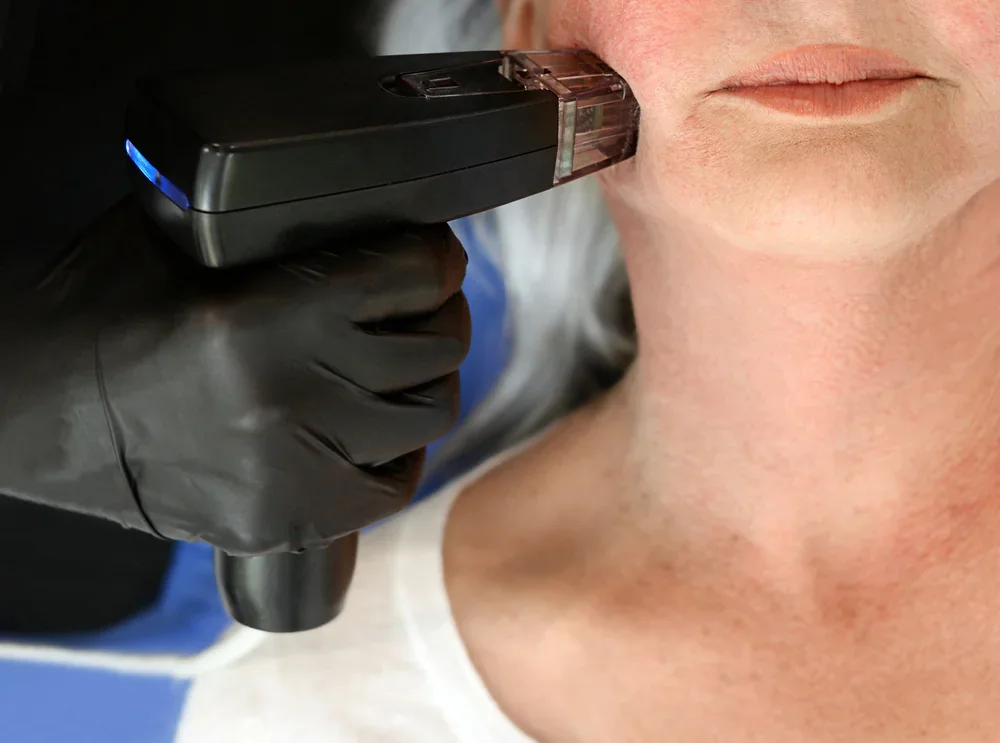
The alternative techniques — powder brows and nano brows — are often a better match for oily skin and active lifestyles. Powder brows deposit pigment in a softer, more diffused pattern that mimics the look of filled-in brows rather than individual hairs. The result tends to hold better over time on oily skin and can look more natural on a wider range of skin tones. Nano brows use a machine needle rather than a hand blade, which allows for more precision and is generally gentler on sensitive skin.
The technique that’s right for you depends on your skin type, your lifestyle, and what you actually want your brows to look like. An honest artist will tell you this before you book — and if they don’t ask about your skin or lifestyle during a consultation, that’s worth noticing. We offer free consultations specifically because this conversation needs to happen before any decisions are made.
Permanent Eyebrows: What You're Actually Buying
Microblading falls under the broader category of permanent eyebrows — a term that covers any technique that deposits pigment into the skin for a lasting result. The reason it’s technically called semi-permanent is that the pigment sits in the upper layer of the dermis, not as deep as a traditional tattoo, so it fades gradually over 12 to 18 months rather than staying indefinitely.
That distinction matters when you’re thinking about cost. You’re not buying a product. You’re buying a result that lives on your face every day for over a year. The math on that looks different when you think about it that way.
Semi-permanent eyebrows: How long do they actually last?
Most clients see their microblading results last between 12 and 18 months before a touch-up becomes necessary. The variation depends on your skin type, how well you follow aftercare instructions, how much sun exposure your face gets, and the quality of the pigment used in the first place.
The healing process itself has a few stages worth knowing. Right after the procedure, the brows will look darker and more defined than the final result. Over the next two weeks, the top layer of skin sheds and the color softens significantly — sometimes so much that clients worry the pigment is gone. It’s not. The final shape and color settle around the two-week mark, and that’s when you’re seeing the actual result.
The 6-to-8-week touch-up is where the artist refines that result. Some strokes may need deepening. Symmetry gets a final check. This appointment is a standard part of the process, and it should be part of the conversation when you’re comparing prices. A session that doesn’t include this follow-up is an incomplete service.
Over the full 12-to-18-month lifespan, the cost of quality microblading starts to look different. Consider what most people spend on brow products — pencils, powders, gels — plus the time spent applying them every morning. At even $15 a month in product alone, that’s $180 to $270 over 18 months. Add in the 10 to 20 minutes a day most people spend on their brows, and the math shifts considerably. Microblading isn’t cheap upfront. But it’s not expensive the way most people think it is, either.
What happens if you go too cheap?
Microblading done poorly is not just a cosmetic disappointment — it’s a problem that’s difficult and expensive to fix. Pigment that’s placed too deep can turn grey or blue-green as it ages. Strokes that aren’t mapped to your facial structure can look asymmetrical or artificial. Pigment that doesn’t match your natural brow color or skin tone can create a result that looks drawn-on rather than grown-in. And if the studio’s sanitation practices aren’t up to standard, you’re taking on a real health risk, not just an aesthetic one.
Correction and removal are options, but they’re not simple. Laser removal typically requires multiple sessions and can cost $200 to $500 or more per session. Saline removal is another route, but it’s also a multi-session process with its own healing requirements. Neither is a quick fix.
The risk of cheap microblading isn’t just that it might look bad. It’s that fixing it takes time, money, and sometimes a lot of patience. Clients who come to us after a difficult experience elsewhere often say the same thing: they wish they’d understood what they were comparing when they made the original decision.
In Wake County, the microblading market spans a wide range — from Groupon deals in the $299 range to credentialed studios charging $600 and above. That range exists because the providers are genuinely different. Not just in price, but in training, technique, pigment quality, and what happens to your brows six months from now.
How to find the right microblading artist in Wake County, NC
Price is a signal, not a verdict. A higher price doesn’t automatically mean a better result — but in microblading, a price that’s well below the local market usually means something is being cut somewhere. The question worth asking is what.
The things that actually protect you are straightforward: a consultation before you book, a portfolio of healed results on real clients, a clear answer about which technique fits your skin, and an artist whose credentials you can verify. If a studio can’t offer those things, the price doesn’t matter much.
At Wake Skincare, Jacqueline Grace has placed first in Pigmentation Artist of the Year at The Skin Games — an international, peer-judged competition — and has been named Best Esthetician in Wake County three consecutive years, including First Place in the Wake Weekly Best of the Best 2022. She also placed second in Lash and Brow Artist of the Year at The Skin Games. These aren’t participation awards. They’re verifiable, skill-based credentials that reflect what the work actually looks like.
Every brow is hand-mapped based on your specific facial structure — no stencils, no guesswork. Because we specialize in skin of color, hyperpigmentation, and oily or acne-prone skin, we can give you an honest answer about which technique is right for you before you commit to anything. We offer free consultations, and there’s no pressure to book. Start there, ask the questions that matter, and make the decision that’s right for you.