Summary:
You’ve tried the serums. Maybe a peel or two. You’ve been consistent, you’ve been patient, and the spots are still there. That’s not a willpower problem — it’s a matching problem. The most common reason dark spot treatments fail is that people are using the right product for the wrong type of spot. Sun damage, post-acne marks, and hormonal pigmentation like melasma don’t share the same root cause, and they don’t respond to the same treatment. Once you understand which kind of dark spot you’re actually dealing with, the path forward gets a lot clearer.
Why the Cause of Your Dark Spots Changes Everything About Treatment
Dark spots form when melanin — the pigment that gives skin its color — is produced in excess and concentrated in one area. But what triggers that overproduction varies widely. UV exposure causes one type of pigmentation. Inflammation from acne causes another. Hormonal shifts cause a third. Each of these involves different skin layers, different biological mechanisms, and different timelines for correction.
This is the part most generic skincare advice skips. When a product promises to “fade dark spots,” it rarely tells you which kind. And when a treatment works beautifully for one person’s sun spots but does nothing for someone else’s post-acne marks, that’s not a coincidence — it’s a mismatch. Getting the right treatment starts with identifying what you’re actually treating.
How to Remove Dark Spots and Pimples from Your Face When Acne Keeps Leaving Marks
Post-inflammatory hyperpigmentation — the dark marks that linger after a breakout heals — is one of the most frustrating skin concerns out there, because it feels like you’re fighting two battles at once. The acne clears, and then you’re left staring at a reminder of it for months. For people with deeper skin tones, this is especially persistent. The American Academy of Dermatology notes that dark spots are among the most common reasons people with melanin-rich skin seek professional care, precisely because the marks can be more pronounced and slower to fade.
Over-the-counter brightening products can help at the surface, but they work slowly and don’t reach the deeper layers where post-inflammatory pigmentation often lives. Ingredients like vitamin C, kojic acid, and niacinamide have real brightening properties, but they typically take three to six months of daily use to produce noticeable results — and that’s assuming the product concentration is high enough to do meaningful work, which most retail formulas aren’t.
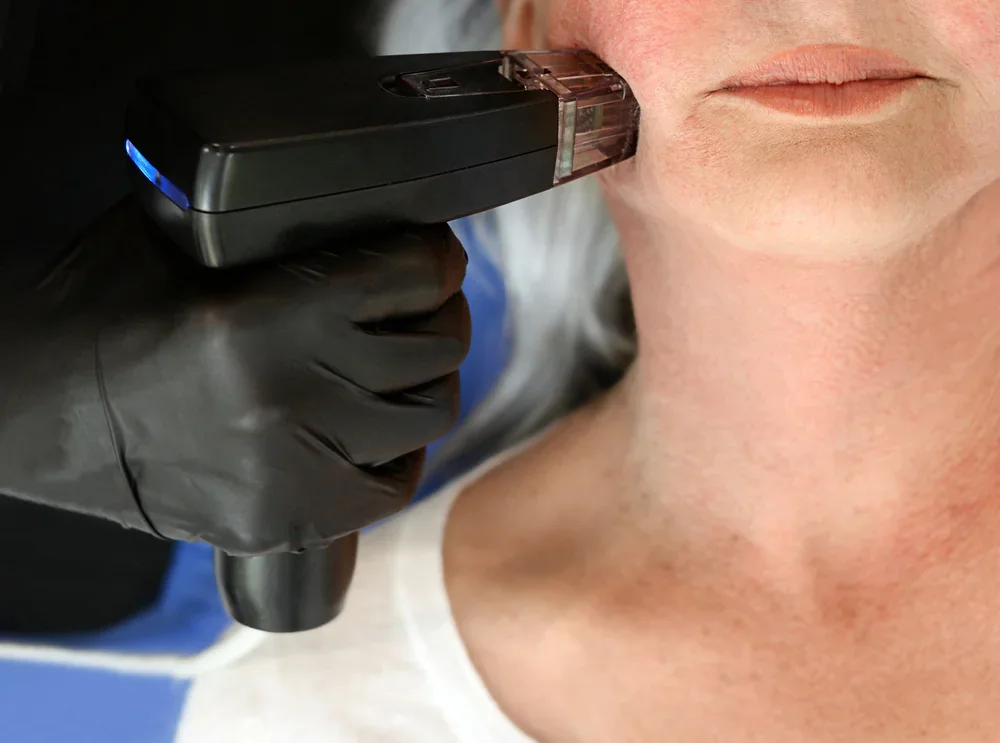
Professional treatments close that gap significantly. SkinPen microneedling creates controlled micro-channels in the skin that stimulate collagen production and accelerate cell turnover, helping to break up pigmentation while also improving skin texture. Chemical peels — particularly glycolic acid-based formulas and the VI Peel — work by accelerating the shedding of pigmented surface cells and triggering new, more even-toned skin beneath. LED light therapy reduces the inflammation that drives new breakouts, which means fewer future spots forming in the first place.
The most effective approach for someone dealing with both active acne and residual dark marks is usually a combination protocol — treating the inflammation and the discoloration together rather than sequentially. That’s not something a single product can do, but it’s exactly what a well-designed professional treatment plan is built for.
One important note for anyone with a deeper skin tone: not all peels and not all lasers are appropriate for melanin-rich skin. Aggressive treatments applied without the right expertise can actually trigger more pigmentation, not less. Choosing a provider who specifically trained in skin of color — and who has the competition results to prove it — matters here more than in markets with less demographic diversity.
Sun Spots vs. Melasma: Why These Two Look Similar But Require Different Approaches
Sun spots — also called solar lentigines or age spots — are caused by cumulative UV exposure over time. They tend to appear on the cheeks, forehead, hands, and chest, and they’re typically flat, well-defined, and consistent in color. If you’ve spent years outdoors in Wake County, NC, where UV levels regularly reach “High” to “Very High” from April through September, sun spots are almost inevitable without diligent protection.
Melasma looks similar on the surface but behaves very differently. It’s driven by hormonal factors — pregnancy, birth control, and hormonal fluctuations are common triggers — and it tends to appear in larger, blotchy patches, often across the upper lip, cheeks, and forehead. Melasma is notoriously stubborn because it’s not just a surface issue. It can affect deeper layers of the skin, and it’s sensitive to heat and UV light, which means certain laser treatments that work well on sun spots can actually worsen melasma if used incorrectly.
For sun spots, treatments that target surface and mid-depth pigmentation work well. Clear & Brilliant, a gentle laser resurfacing treatment, addresses sun damage by promoting cell turnover and collagen production. One client who came in for sun damage reported that her dark spots were almost completely gone after just two sessions — a result that reflects what the right treatment for the right concern can accomplish. Chemical peels and HydraFacial with brightening boosters containing vitamin C, kojic acid, and tranexamic acid are also effective for surface-level sun damage, with the added benefit of immediate visible improvement after a single session.
For melasma, the approach needs to be more deliberate. Heat-generating treatments require careful calibration, and the protocol often involves a combination of topical brightening agents and gentler professional treatments spaced strategically. Timing matters too — fall and winter are the optimal treatment window in Wake County, when sun exposure is minimal and the skin isn’t constantly re-triggering pigmentation between appointments. A provider who understands the distinction between melasma and sun damage, and who builds a plan accordingly, is going to get meaningfully better results than one who applies the same protocol to every pigmentation concern.
What Separates a Provider Who Can Actually Fix Dark Spots from One Who Can't
The market is full of medspas and skincare clinics that list “hyperpigmentation treatment” among their services. Most of them are not wrong to do so — but listing a service and having deep, specialized expertise in it are different things. When you’re choosing someone to treat your dark spots, the credential that matters most isn’t the broadest — it’s the most specific.
Pigmentation treatment requires understanding skin type, melanin depth, the cause of the discoloration, and how different modalities interact with different skin tones. A provider who skips the consultation, applies a one-size-fits-all peel, and sends you home with a generic aftercare sheet is not practicing at that level. The difference shows up in your results.
What Credentials Should Actually Matter When Choosing a Dark Spot Specialist
Most people searching for dark spot treatment don’t know what credentials to look for beyond “licensed esthetician” or “board-certified.” Those are baseline requirements, not differentiators. The question worth asking is whether the provider has demonstrated, verifiable expertise specifically in pigmentation — not just general skincare.
The Skin Games is an international esthetician competition that judges practitioners on real, documented client transformation over an eight-week period. The Pigmentation Artist of the Year category is evaluated on visual improvement, methodology, and case documentation — meaning competitors are judged on whether their clients’ skin actually changed, not on theoretical knowledge. Winning first place in that category, against practitioners from around the world, is a direct measure of clinical skill.
Jacqueline Grace, founder of Wake Skincare, placed first in the Pigmentation Artist of the Year category at The Skin Games — and placed second in a separate year. She has also been named Best Esthetician in Wake County for three consecutive years, including First Place in Wake Weekly Best of the Best 2022, which is a community-recognized distinction voted on by local residents, not a self-reported award. She holds HydraFacial certification at all three levels — Professional, Expert, and Master — and was among the first 100 practitioners in the world to achieve the Master level.
These are credentials you can look up. They’re not marketing language. And they matter because pigmentation treatment is one of the areas where the gap between a generalist and a specialist produces measurably different outcomes for clients. Particularly for clients with melanin-rich skin, where the wrong approach can worsen pigmentation rather than correct it, working with someone who has won an international competition specifically for this concern is not a luxury — it’s the point.
We also offer free consultations and skin evaluations, so there’s no financial barrier to getting a professional opinion before committing to any treatment plan.
Why Wake County Residents Deal with Dark Spots Differently Than Most Markets
Wake County’s climate is a real factor in why so many residents are dealing with persistent dark spots. Raleigh, Wake Forest, Rolesville, Youngsville, and surrounding communities sit in a region where UV levels climb into the “High” to “Very High” range for roughly six months of the year. That’s a long season of cumulative sun exposure, and it builds up. Residents who spend time outdoors at youth sports, on trails, or even just commuting and running errands are absorbing more UV than they may realize, and that exposure shows up on the skin over time.
The county’s rapid growth adds another layer. With more than 1.2 million residents and roughly 66 new people arriving every day, a significant portion of Wake County’s population relocated from regions with different sun exposure profiles. People who moved here from the Northeast or Pacific Northwest may be experiencing more intense UV exposure than they’re accustomed to, and their skin is showing it.
Wake County’s demographic diversity is also relevant in a way that most dark spot content doesn’t address directly. A substantial portion of the local population has melanin-rich skin, and for those individuals, hyperpigmentation is both more common and more consequential. The risk of post-inflammatory hyperpigmentation from incorrectly calibrated treatments is real, and it’s why working with a provider who specifically trained in skin of color — and who has the competition results to prove it — matters here more than in markets with less demographic diversity.
We serve clients across more than 20 communities throughout Wake County and the surrounding region. Our Wake Forest location puts us in the northern part of the county, accessible to residents who would otherwise need to drive into Raleigh for this level of specialized care. For clients who’ve spent years trying treatments that didn’t work, the proximity and the expertise together make a difference.
Finding the Right Dark Spot Treatment Starts with Knowing What You're Actually Treating
If there’s one thing worth taking away from all of this, it’s that dark spots are not a single problem with a single solution. The type of spot, your skin tone, your skin’s history, and even the time of year all shape which treatment will actually work for you. That’s not a reason to feel overwhelmed — it’s a reason to stop guessing and get a real assessment from someone who specializes in exactly this.
Most people who come to us frustrated with dark spots have already tried something. They’ve done the serums, maybe a peel somewhere else, and they’re not seeing the results they expected. That frustration is valid, and it’s usually fixable — once the right treatment is matched to the right concern.
If you’re ready to find out what’s actually driving your dark spots and what a realistic treatment plan looks like for your skin, Wake Skincare offers free consultations with no pressure and no commitment required. Start there.